

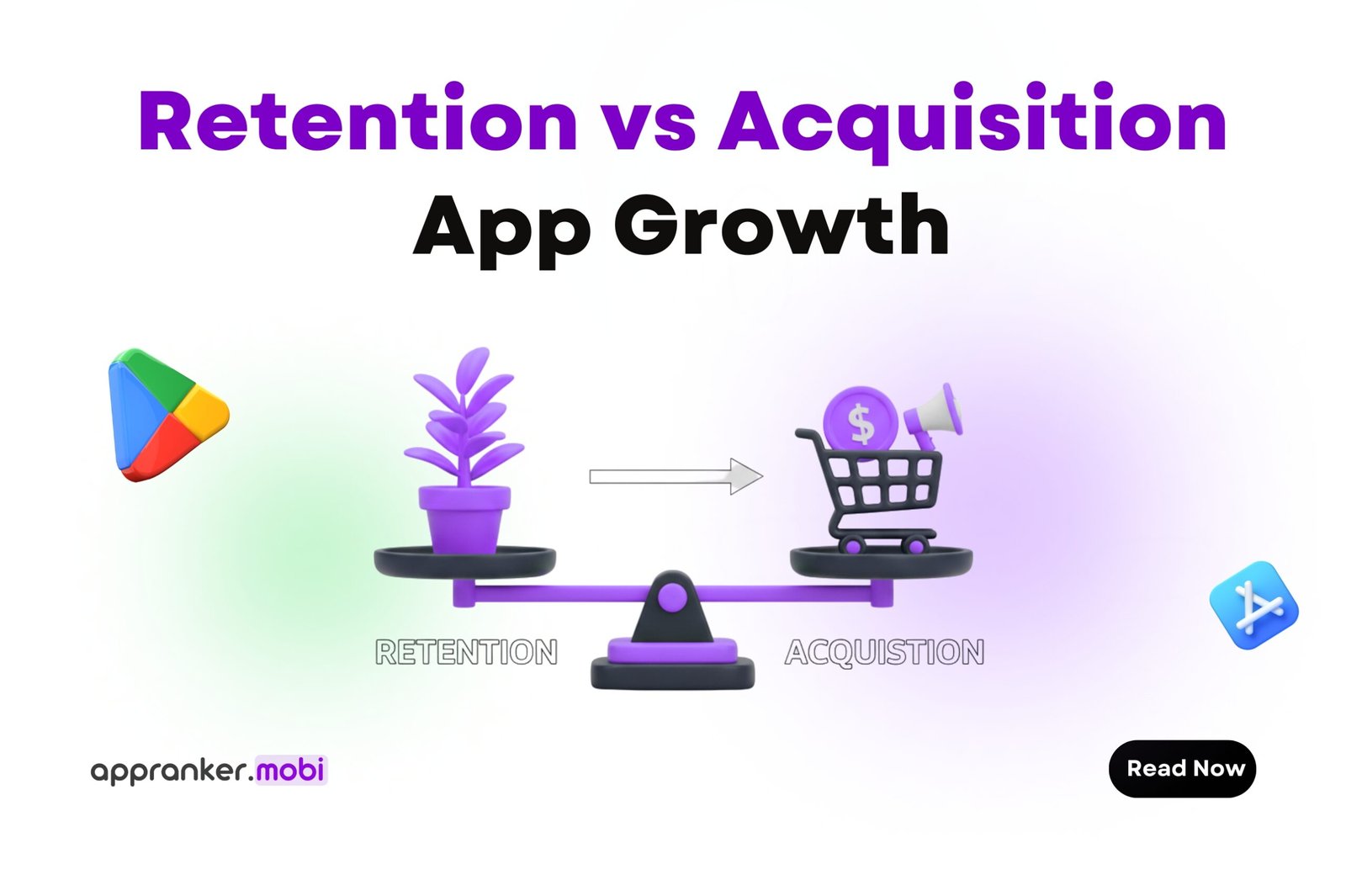

Retention vs Acquisition App Growth?
App growth is often framed as a race for installs. Many teams invest heavily in ads, influencer campaigns, and launch pushes to acquire users quickly. But after the initial spike, growth stalls.
This leads to an important question: retention vs acquisition — which actually drives app growth?
The answer isn’t as simple as choosing one over the other. This guide explains how retention and acquisition work together, why retention increasingly matters more, and how the right balance drives sustainable app growth.
Understanding App Acquisition
Acquisition is the process of bringing new users into your app.
Common acquisition channels include:
-
Paid ads
-
App Store Optimization (ASO)
-
Influencer marketing
-
Content and SEO
-
Referrals
Acquisition is essential — without users, there is no growth. However, acquisition alone does not guarantee success.
Many apps acquire users efficiently but fail to grow because users don’t stay.
Understanding App Retention
Retention measures how many users continue using your app after installation.
Typical retention benchmarks:
-
Day 1 retention
-
Day 7 retention
-
Day 30 retention
Retention reflects:
-
Product-market fit
-
Quality of onboarding
-
Ongoing value delivery
Strong retention means users find consistent value in your app.
Retention vs Acquisition App Growth: The Core Difference
Acquisition brings users in.
Retention keeps users active.
Here’s the key distinction:
-
Acquisition creates opportunity
-
Retention creates growth
If users leave quickly, acquisition spend is wasted. If users stay, growth compounds.
This is why retention vs acquisition app growth is one of the most critical debates in mobile marketing.
Why Retention Drives Long-Term App Growth
Retention impacts growth in multiple ways:
1. Retention Improves App Store Rankings
App stores prioritize engagement and retention signals.
Apps with strong retention:
-
Rank higher for keywords
-
Maintain ranking stability
-
Recover faster after updates
High churn sends negative signals that suppress visibility.
2. Retention Increases Lifetime Value (LTV)
Retained users:
-
Spend more time in the app
-
Convert to paid plans more often
-
Generate ad revenue consistently
Higher LTV allows teams to spend more confidently on acquisition.
3. Retention Reduces Acquisition Costs
When retention improves:
-
Organic installs increase
-
Word-of-mouth grows
-
Referral loops strengthen
This lowers overall cost per install (CPI) and dependency on ads.
Why Acquisition Still Matters
Retention alone cannot drive growth without a steady inflow of new users.
Acquisition matters because:
-
It fuels the top of the funnel
-
It tests new audiences
-
It accelerates early momentum
-
It feeds retention systems
Even the best-retained app needs consistent discovery.
The Problem With Over-Focusing on Acquisition
Many apps fail because they prioritize acquisition over retention.
Common issues include:
-
High uninstall rates
-
Poor reviews
-
Rising CPI
-
Low monetization
Acquiring more users into a broken experience only amplifies problems.
This is where retention vs acquisition app growth becomes a strategic decision — not a marketing one.
The Ideal Balance: Retention First, Acquisition Second
High-growth apps follow a clear sequence:
-
Fix onboarding and activation
-
Improve early retention
-
Optimize engagement and UX
-
Scale acquisition confidently
Retention creates a strong foundation. Acquisition then accelerates growth safely.
How Retention and Acquisition Work Together
Retention and acquisition are not competitors — they are multipliers.
Strong retention:
-
Improves conversion of paid traffic
-
Increases organic discovery
-
Enhances referral performance
Strong acquisition:
-
Provides data for retention optimization
-
Expands audience reach
-
Tests positioning and messaging
The best growth systems align both.
Metrics That Matter in Retention vs Acquisition App Growth
Track both sides intelligently.
Acquisition Metrics:
-
Install volume
-
Cost per install (CPI)
-
Store page conversion rate
Retention Metrics:
-
Day 1 / Day 7 / Day 30 retention
-
Session frequency
-
Uninstall rate
-
Lifetime value (LTV)
Growth happens when retention metrics improve alongside acquisition scale.
Common Mistakes Teams Make
-
Scaling ads before fixing retention
-
Measuring installs instead of usage
-
Ignoring early churn signals
-
Treating retention as a product-only issue
Growth requires alignment between product, marketing, and data teams.
What Retention vs Acquisition Can and Cannot Do
Retention CAN:
-
Improve rankings and visibility
-
Increase revenue per user
-
Reduce acquisition costs
-
Drive sustainable growth
Acquisition CAN:
-
Increase reach quickly
-
Test new markets
-
Accelerate early traction
Neither CAN:
-
Fix a poor product alone
-
Guarantee growth without balance
Final Takeaway
When it comes to retention vs acquisition app growth, retention is the engine and acquisition is the fuel.
Apps that grow sustainably:
-
Prioritize retention first
-
Align acquisition with product readiness
-
Measure engagement, not just installs
-
Optimize continuously
Acquisition gets users in the door — but retention is what keeps growth alive.